Podcasts
Link to the book http://bit.ly/GavinAubrey
Gavin has trained and coached over 10,000 people from New York
to Kazakhstan, London to Sydney. Having spent all of that time with
so many people in so many different situations, he has picked up many
clues into what makes us tick.
This is his guide to motivation, happiness, success & resilience.
Posted by admin,
14th August 2017, 1:00am
No. of Comments: No Comments
Category: Articles, Podcasts, Press Releases
Podcast: Download (Duration: 13:11 — 15.1MB)

Having courageous conversations ranks in the top 3 coaching areas I come across when I work with people.
Let a process take the strain… we spend a disproportional amount of time worrying about them compared to carrying them out!
Posted by admin,
7th July 2016, 10:23am
No. of Comments: No Comments
Category: Podcasts
Podcast: Download ()
Behaviour is the tip of the iceberg. What drives it lies beneath – how we feel and what we believe. Unfortunately, while we may think we can control the way we feel external factors tend to take control.
However, it is your mind… you can take back the control!
Posted by admin,
17th November 2015, 12:27pm
No. of Comments: No Comments
Category: Podcasts
Podcast: Download ()
Do you think you believe what you see…. or see what you believe?
Count the number of Fs in the italic sentence below… check out the video to see if you are right.
We are a tad complicated!
FINISHED FILES ARE THE RES
ULT OF YEARS OF SCIENTI
FIC STUDY COMBINED WITH
THE EXPERIENCE OF YEARS
Posted by admin,
28th July 2015, 4:43pm
No. of Comments: No Comments
Category: Podcasts
Podcast: Download (Duration: 5:45 — 5.3MB)

The benefits of being grateful are quite… extraordinary.
You become happier, less envious, exercise more, improve your physical health … and many more cool things happen.
Don’t take my word for it check it out in google land.
You are what you think that”s for sure.
Posted by admin,
20th June 2014, 3:56pm
No. of Comments: No Comments
Category: Podcasts
Podcast: Download ()
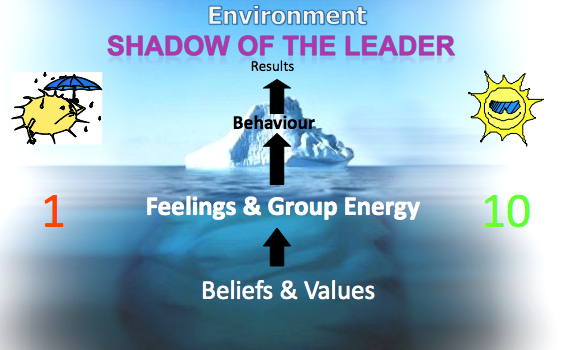
If people are looking to you for direction or inspiration then there is a good chance you are a Leader.
It doesn’t have to be in a business environment… you could be a school football coach, a community head, a business manager or a parent….you are probably a Leader… and therefore you cast a Leadership Shadow.
What’s yours like!!
Posted by admin,
22nd October 2013, 5:25pm
No. of Comments: No Comments
Category: Podcasts
Podcast: Download (Duration: 12:45 — 11.7MB)

The world at the moment is as mad as a box of frogs!
Cases of depression & stress are going through the roof.
When you have strong resilience you can cope with stress and adversity… you can bounce back. The world can change as much as it wants…. you’ve got a giant space-hopper!
When it’s low ……the inevitable speed of change wears and tears you down.
Keeping your resilience charged and topped up is essential for a bright and happy future… it’s free, just like air used to be in a garage!
Posted by admin,
7th March 2013, 2:57pm
No. of Comments: No Comments
Category: Podcasts
Podcast: Download ()

Probably the most important relationship you have is …
… the one you have with your boss.
The number one reason why people leave their job is not down to money, it’s down to their relationship with…
..the boss ..the big cheese…the head honcho
In that case it might be worth having a strategy!!!
Managing your boss click here for pdf
Posted by admin,
13th November 2012, 1:10pm
No. of Comments: No Comments
Category: Podcasts
Podcast: Download ()
I’ve worked with thousands of people around the world. In most cases their number one goal is to be happy.
Now that’s interesting as happiness is just a thought away…
Posted by admin,
23rd October 2012, 4:57pm
No. of Comments: No Comments
Category: Leadership, Podcasts
Podcast: Download ()

A really useful technique for the following scenarios:
When you think your ideas might meet resistance
When you are not sure or confident on how your ideas will land
When the solution for someone else’s problem is so obvious… but still they can’t see it!!
Have fun
Gavin
Posted by admin,
21st August 2012, 1:08pm
No. of Comments: No Comments
Category: Podcasts
Podcast: Download ()

They are called difficult conversations for a reason!
In my experience very few people like to have them, and very few of them seem to go well.
A true lose/lose.
Sometimes you have to tell them how it is, however on many occasions you can get them to tell you how it is…. give themselves a good talking to!
Posted by admin,
21st June 2012, 5:06pm
No. of Comments: No Comments
Category: Podcasts
Podcast: Download ()
Guided Relaxation

When you relax your body, you relax your mind. When you relax your mind you tap into the power of the sub conscious.
Sometimes in order to achieve more you have to do less!
Sometimes it’s just good to step off the world and …. let go
Posted by admin,
20th February 2012, 11:22pm
No. of Comments: No Comments
Category: Podcasts
Podcast: Download ()
I’m an ENTP…help

The Guru trainer walked into the room and said..
“which one is the ENTP”
I raised my hand and said..
“that will be me”
He looked at me and said ” don’t worry, it will be alright” … and then left the room
Ever feel a little different to the world!!
Posted by admin,
3rd February 2012, 4:32pm
No. of Comments: No Comments
Category: Podcasts
Podcast: Download (10.1MB)
Coping with this mad world

The world is nuts (technical term!!) at the moment…. and it’s not likely to change.
If you find yourself going around the hamster wheel like a loon.. step off and do something different.
Sometimes we forget who we are and what we are trying to do… you need a little peace… to piece it back together!
Posted by admin,
30th January 2012, 10:42am
No. of Comments: No Comments
Category: Podcasts
Podcast: Download (Duration: 4:13 — 28.1MB)
A live conference speech with Gavin demonstrating “which way do you eat your banana?”
60,000 thoughts a day, 90% the same as the ones you had yesterday…. no wonder we get a little testy when asked…
“which way do you eat your banana?”
Posted by admin,
2nd November 2010, 6:45pm
No. of Comments: No Comments
Category: Podcasts
Podcast: Download (Duration: 17:41 — 16.2MB)
Do you have a team that does not always play to win? Do you feel more like a referee in a fighting ring, some days than a manager?
Don’t worry if you do, the good news is that people are not designed to work in team. Think ‘survival of the fittest’ we have a natural instinct to be competitive in order to survive…so it is completely normal for things to kick off a little!!
At Think, we believe that, whilst rivalry and competitiveness is healthy, you should never excel at another persons loss or expense. To help you unite your team to work together to achieve common goals why not try our Team Skills course.
Posted by Gavin,
19th July 2010, 1:32pm
No. of Comments: No Comments
Category: Leadership, Podcasts
Podcast: Download (Duration: 26:42 — 36.7MB)
Ok, so it’s not quite The Matrix, but the answer to this question will help you get what you want… and it’s right here on this podcast.
Listen to this podcast for the four (yes, just four) steps to great Influencing Skills.
If you’d like to explore how Think Training & Development can help you with your own influencing skills or the general communication within your company, we’ll be waiting in the green box, to listen to what you need. Give us a call or drop us an email.
Posted by Gavin,
12th April 2010, 3:01pm
No. of Comments: No Comments
Category: Leadership, Podcasts
Podcast: Download (Duration: 33:30 — 46.0MB)
Sounds too good to be true, doesn’t it?
At Think, we have produced some seriously impressive results from each business we have been involved with. How?
Listen to the podcast for the 4 basic principles that have been the bedrock of our success.
If your particular department isn’t sales related, we think you will still be able to apply the principles to get the results you’re looking for. more…
Posted by Gavin,
17th March 2010, 12:47pm
No. of Comments: No Comments
Category: Leadership, Podcasts
Podcast: Download (92.1MB)
This podcast is the last in a series of 3 which explore the personality type theory of Myers-Briggs®.
This one looks at:
- How people prefer to make decisions –Logic and objectivity or values and relationships?
- How people live their lives – Planned and organised or spontaneous and adaptable?
It will give you some clues as to:
- Why some people want to be recognised for their achievements while others need to be appreciated for their efforts.
- Why some people love to start things off…while others love to finish them!
If you’d like to know more about your personality type or those of your team members, check out our Myers-Briggs® courses, run by qualified Myers-Briggs® practitioners. Special Offers apply.
Posted by Gavin,
3rd March 2010, 10:03am
No. of Comments: No Comments
Category: Podcasts
Podcast: Download (Duration: 9:56 — 25.4MB)
This podcast is the second in a series of 3 which explore the personality type theory of Myers-Briggs®.
This one looks at how people prefer to take in information – high level or highly detailed?
It will give you some clues as to why some people see the wood first…while others see the trees.
If you’d like to know more about your personality type or those of your team members, check out our Myers-Briggs® courses, run by qualified Myers-Briggs® practitioners. Special Offers apply.
Posted by Gavin,
23rd February 2010, 2:45pm
No. of Comments: No Comments
Category: Podcasts
Podcast: Download (Duration: 17:57 — 45.9MB)
This podcast is the first in a series of 3 which explore the personality type theory of Myers-Briggs®.
This one looks at how people are energised – through internal or external stimuli.
It will give you some clues as to why some people dive in and act before they think things through while others think carefully before they act.
If you’d like to know more about your personality type or those of your team members, check out our Myers-Briggs® courses, run by qualified Myers-Briggs® practitioners. Special Offers apply.
Posted by Gavin,
16th February 2010, 4:08pm
No. of Comments: No Comments
Category: Podcasts
Podcast: Download (Duration: 6:12 — 5.7MB)

Nothing to do with magic…well not the circus kind anyway!
If you have something important to do such as a presentation or a big meeting, there are some really easy actions you can take to get yourself in the right frame of mind to succeed. Listen to this podcast to find out more… Or take a look at our page on advanced presentation skills.
Posted by Gavin,
9th February 2010, 10:04am
No. of Comments: No Comments
Category: Leadership, Podcasts
Podcast: Download (Duration: 19:04 — 13.1MB)
Have you ever asked yourself what drives human behaviour? Why people sometimes act in ways that you find difficult to understand?
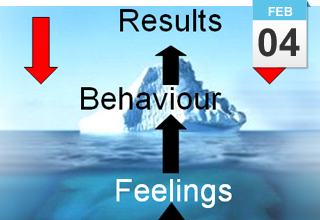
Imagine an iceberg. The tip is above water – you can see this. The majority of the iceberg is under the water – hidden from view.
A person’s behaviour is like the tip of the iceberg – the part you can see. What drives that behaviour lies underneath the surface. Venture below surface level and you’ll discover the values, beliefs, experiences and thoughts that drive a person’s behaviour.
Listen to the podcast to find out more.
If you’d like to better understand and influence the behaviour of the people in your team, a good place to start is with some Myers Briggs or Influencing Skills training.
Posted by Gavin,
4th February 2010, 4:55pm
No. of Comments: No Comments
Category: Leadership, Podcasts
Podcast: Download (Duration: 28:55 — 26.5MB)
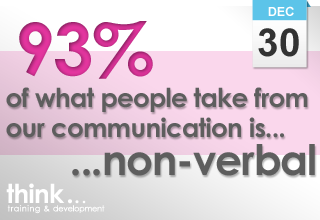
There have been many studies on how non-verbal behaviour (body language such as facial expressions, gestures etc) impact communication.
Back in the 1950s, Dr Ray Birdwhistell was one of the first to suggest that no more than 30% to 35% of the social meaning of a conversation or an interaction is carried by words. (There were others before him but Dr B has by far the coolest name, so we like him best).
Today, there is a strong school of thought that, when we communicate, people pay attention to our words and actions as follows:
more…
Posted by Gavin,
30th December 2009, 4:21pm
No. of Comments: No Comments
Category: Leadership, Podcasts
Podcast: Download (Duration: 5:24 — 21.6MB)
Words, by their nature, are ambiguous. Why? Because we each give different words meaning – depending on our own experiences, beliefs, values, thoughts and ideas.
This video demonstrates this through a simple ‘ice breaker’ training exercise on…sex!
Take a look and you’ll see what we mean. No giggling like school kids now. This is a serious and highly scientific lesson in Communication Skills. Oh, ok then, it’s just a bit of fun…
But seriously…if we cannot agree on the meaning of a universally acknowledged, simple little word like ‘sex’, what hope do we have of ever being properly understood?
If you want to improve the clarity and impact of your communication, take a look at our Communication Skills courses or Contact Us to talk through what you need.
P.S. We run this exercise a lot and ‘love’ doesn’t come up too much. Shame on everyone. And whoever said ‘Zygot’ in a recent session – well that’s just weird.
Posted by Gavin,
29th December 2009, 10:55am
No. of Comments: No Comments
Category: Podcasts
Podcast: Download (Duration: 16:33 — 11.4MB)
Being an effective coach can have an astonishing impact on the people you work with. Trust me, the personal rewards you get are out of this world and the business benefits can be far reaching.
Listen to the podcast for tips on:
- Questioning & listening techniques
- Types of coaching question to ask
You cannot hope to influence a change in someone’s behaviour until they understand:
- Where they are now
- Where they want or need to get to
- What is holding them back
- What choices and options they have to move forward
If you’d like to know more about how to influence staff behaviour, check out our Influencing Skills courses, Executive Coaching or Contact Us and tell us what you need.
Posted by Gavin,
22nd September 2009, 12:54pm
No. of Comments: No Comments
Category: Leadership, Podcasts
Podcast: Download (Duration: 6:04 — 17.6MB)
Apparently, as a human being, you have 60,000 thoughts a day; 90% are the same ones you had yesterday, and the day before, and the day before.
We tend to live out our lives ticking to an habitual beat. Sometimes you just need to ask yourself “which way do i eat my banana?”
Posted by Gavin,
8th September 2009, 10:47am
No. of Comments: No Comments
Category: Podcasts